





Achieving carbon neutrality
Record-breaking heatwaves, torrential rains, and droughts have occurred frequently on a global scale in recent years. Natural disasters caused by climate change are posing a more serious threat to Japan as well. For this reason, people around the world are becoming increasingly aware of the need to reduce greenhouse gas emissions, which are considered a major contributor to climate change. Addressing global warming caused by climate change is an urgent issue for the Calbee Group, which values and makes the most of nature’s bounty.
Calbee has set a target (KPI) to reduce total greenhouse gas emissions by 30% (compared to the fiscal year ended March 31, 2019) by 2030 and is moving forward accordingly.
We are promoting energy-saving activities and using renewable energy to reduce our Scope 1 and 2 emissions. We are strengthening our engagement with suppliers to address the reduction of our Scope 3 Category 1 emissions, which is challenging to achieve without their cooperation. In line with these activities, we will set targets and reduce them.
Main initiatives
Scope 1 and 2 emissions reduction
Energy Conservation Committee's activities
We have established an Energy Conservation Committee to promote energy conservation, and departments across our factories work together to this end. The Committee promotes continuous energy-saving efforts by, for example, visualizing energy usage, setting improvement goals, and sharing best practices from Calbee factories. At the Kansai Biwako Factory, we focused on reducing electricity consumption through capital investment and improvements to the operation of boilers and steam equipment in order to increase energy efficiency. We are also considering the introduction of renewable-energy systems, such as solar power generation systems. Through these efforts, we are working to improve energy efficiency and reduce the burden our operations place on the environment.
These initiatives will result in lower CO2 emissions, contributing to the reduction of greenhouse gas emissions.
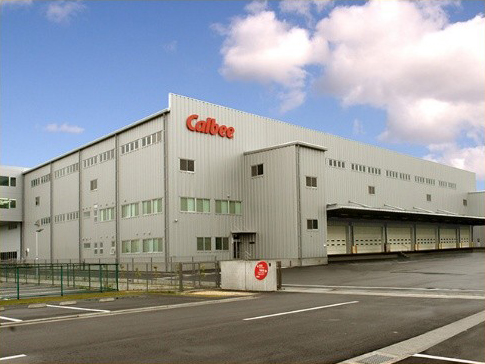
Energy-saving initiatives are implemented at the Kansai Biwako Factory.
Energy savings through a smart energy project in the Kiyohara Industrial Park
Three Calbee business locations, namely, Shin-Utsunomiya Factory, Kiyohara Factory, and the R&D Center, have been participating in a smart energy project in collaboration with neighboring companies since February 2020. The smart energy project uses energy efficiently through the Kiyohara Smart Energy Center (hereinafter, Kiyohara SEC) established in the Kiyohara Industrial Park in Utsunomiya City, Tochigi Prefecture.
With this project, energy demand can be monitored in real-time based on information such as outdoor conditions, which change daily, the status of energy use in each factory, and the operational status of heat source equipment. By supplying heat and electricity produced at Kiyohara SEC to each factory according to demand, we aim to conserve energy and reduce greenhouse gas emissions for the entire industrial park. Significant results, which Calbee could not achieve alone, are made possible through collaboration with the local community and fellow companies.
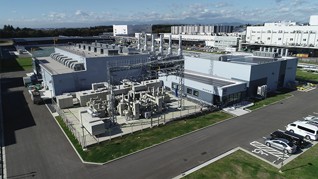
Kiyohara Industrial Park
Carbon offsetting of thermal energy
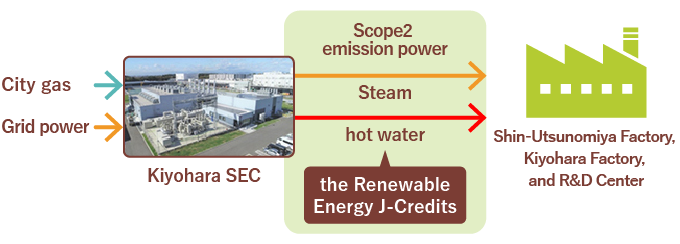
Carbon offsetting of thermal energy Calbee, Inc. and Tokyo Gas Engineering Solutions Corporation have commenced efforts to reduce Calbee’s CO2 emissions from thermal energy, necessary for its production process, to net zero at Calbee’s three business locations participating in the smart energy project (Shin-Utsunomiya Factory, Kiyohara Factory, and R&D Center) located within Kiyohara Industrial Park, using the Renewable Energy J-Credit Scheme*1. Calbee has been using electricity generated from renewable energy at its factories throughout Japan, but this is the first-ever attempt to offset its CO2 emissions from thermal (steam/hot water) energy. J-credit is allocated to offset CO2 emissions from heat (steam/hot water) supplied from Kiyohara SEC to Calbee's three business locations.
*1 A scheme in which CO2 emissions reduced through the use of renewable energy are certified as credits by the Japanese government (from the Ministry of Economy, Trade and Industry website)
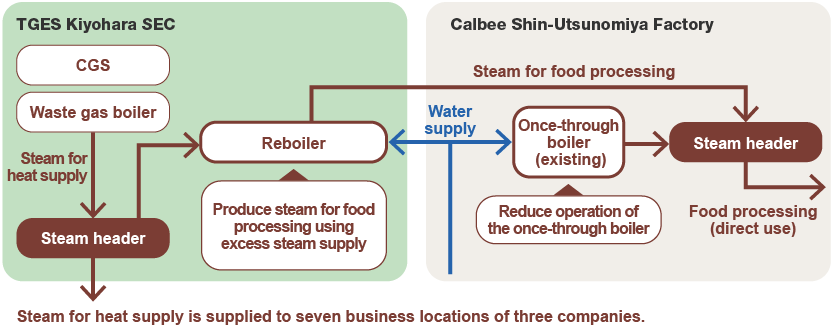
Use of steam generated from waste heat
At the Calbee Shin-Utsunomiya Factory, we formerly produced and used steam that comes in direct contact with food products in boilers fueled by municipal gas. In FY2022, we introduced reboilers at the Kiyohara Smart Energy Center as part of the smart energy project. The reboilers utilize steam generated from waste heat to produce steam for food processing, thereby reducing municipal gas consumption.
Steam Generation from Potato Residues
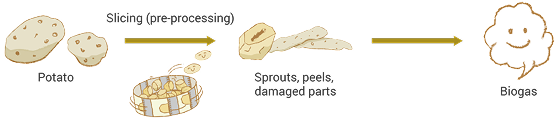
The production process at the Setouchi Hiroshima Factory generates potato sprouts, peels, damaged parts, and other potato residues. These would normally be discarded, but the factory regards them as valuable resources. Potato sprouts, peels, and damaged parts undergo methane fermentation, and the resulting biogas is used to generate steam. Steam is essential to the food manufacturing process, and using biogas to generate this steam reduces greenhouse gas emissions.
Use of renewable energy
Since the fiscal year ended on March 31, 2020, we have been transitioning from purchasing conventional fossil fuel-generated electricity to electricity with non-fossil fuel energy certificates (renewable energy designation)*2, as well as purchasing electricity from solar power generation, among other measures.
Currently, 11 factories purchase and utilize electricity generated from renewable energy sources.
Factories using renewable energy
| Start of usage | Factory name |
|---|---|
| 2020 | Shimotsuma, JFL Koga, Hokkaido |
| 2021 | Kagoshima, Gifu Kakamigahara, Kansai Biwako, Kyoto, Hiroshima Miyajima, Hiroshima Hatsukaichi |
| 2024 | Obihiro |
| 2025 | Setouchi Hiroshima |
Introduction of solar power generation system
Solar power generation systems were installed on top of the Kyoto Factory Hiroshima-Miyajima Factory and Setouchi-Hiroshima Factory to generate electricity using solar panels. The reduction in emissions is equivalent to 259 tons of CO2 annually.
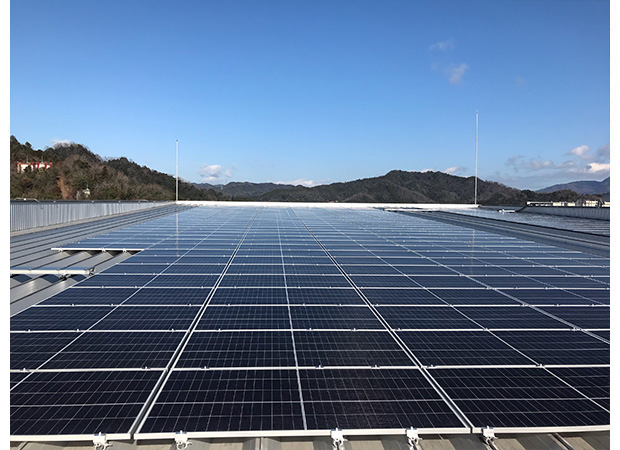
Solar panels
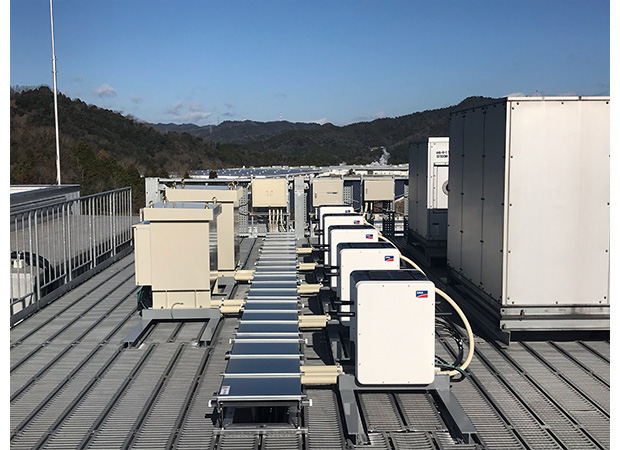
Solar power generation system
Scope 3 emissions reduction
Initiatives with contract potato growers
We conduct interviews with contract potato growers to confirm the amount of fertilizer and pesticides used in the cultivation process, as well as the fuel used in farm equipment. A partial calculation is then made of greenhouse gas (GHG) emissions for each contract grower. While increasing the number of contract growers, for which calculations are made, we are also moving forward with efforts to reduce emissions. This includes collecting and examining information regarding fuel as the primary source of emissions, as well as exploring the possibility of using new fuels in farm equipment.
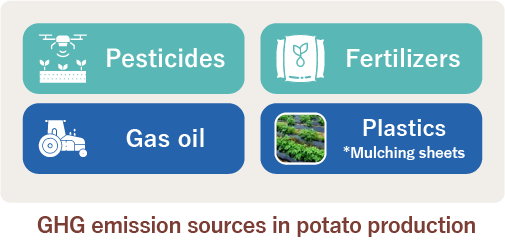
Initiatives with suppliers: strengthening engagement
To reduce Scope 3 emissions related to raw materials such as film and cardboard, it is essential to obtain primary data* from suppliers. We request cooperation from some suppliers and calculate greenhouse gas (GHG) emissions. We also promote emissions reduction efforts in collaboration with our suppliers. We obtain primary data from suppliers accounting for approximately 30% of our Scope 3 Category 1 emissions, such as those resulting from raw materials.
We have also begun GHG emissions reduction initiatives with suppliers and are working to reduce GHG emissions in the entire supply chain through various measures including energy transition.
* Primary data is data derived from specific activities within a supplier's value chain, such as emissions data provided directly by suppliers.
Figure 5: Calculation of emissions using secondary data (conventional method) and calculation of emissions using primary data
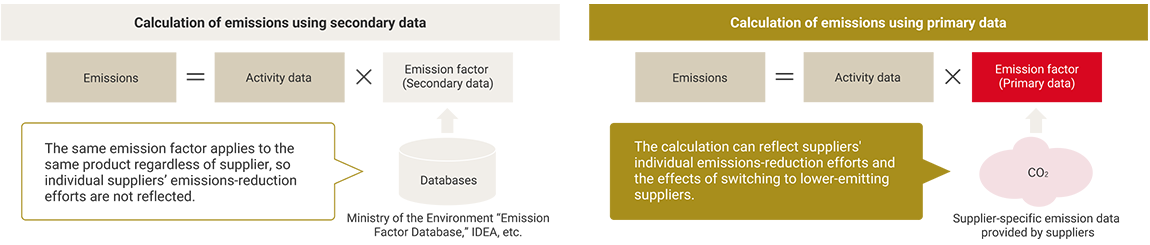
※ Source: Guidelines for calculating supply chain emissions using primary data, p. 23, Figure 5
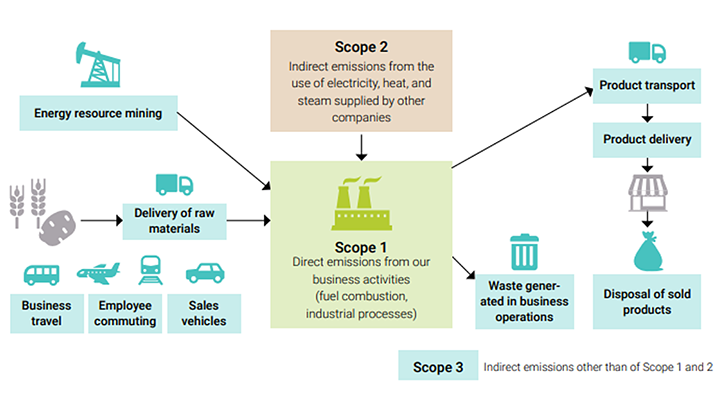
Scope3 and Scope1,2