



Maximization of human capital toward realizing Active Roles for All Employees
Achieving growth simply by applying previous business strategies is becoming more difficult due to various factors, such as a shrinking market resulting from Japan's declining and aging population, growing health awareness, diverse dietary habits, and growing climate-related risks to ingredient procurement. In this changing environment, we at the Calbee Group regard our people as the source of competitiveness, the driving force behind corporate value, and the most critical business foundation for sustainable growth. We are therefore focused on promoting human capital management.
Overview of human capital management
To achieve our growth strategy, "Accelerate the Future," we at the Calbee Group place the philosophy of "Active Roles for All Employees," which is built upon the spirit of altruism that we have upheld since the establishment of the company, at the heart of our human capital management.
To practice human capital management, we have redefined "Active Roles for All Employees" as "empowering diverse talent to use their strengths and to experience pride and joy in contributing to Calbee, to society, and to their personal growth." We believe it is important to provide an environment that allows all employees to identify the purpose of their roles, rise to the challenge, and achieve personal and professional growth. The ongoing efforts that each and every employee makes will undoubtedly boost our competitiveness and improve the value we offer to society.
Creating value through human capital
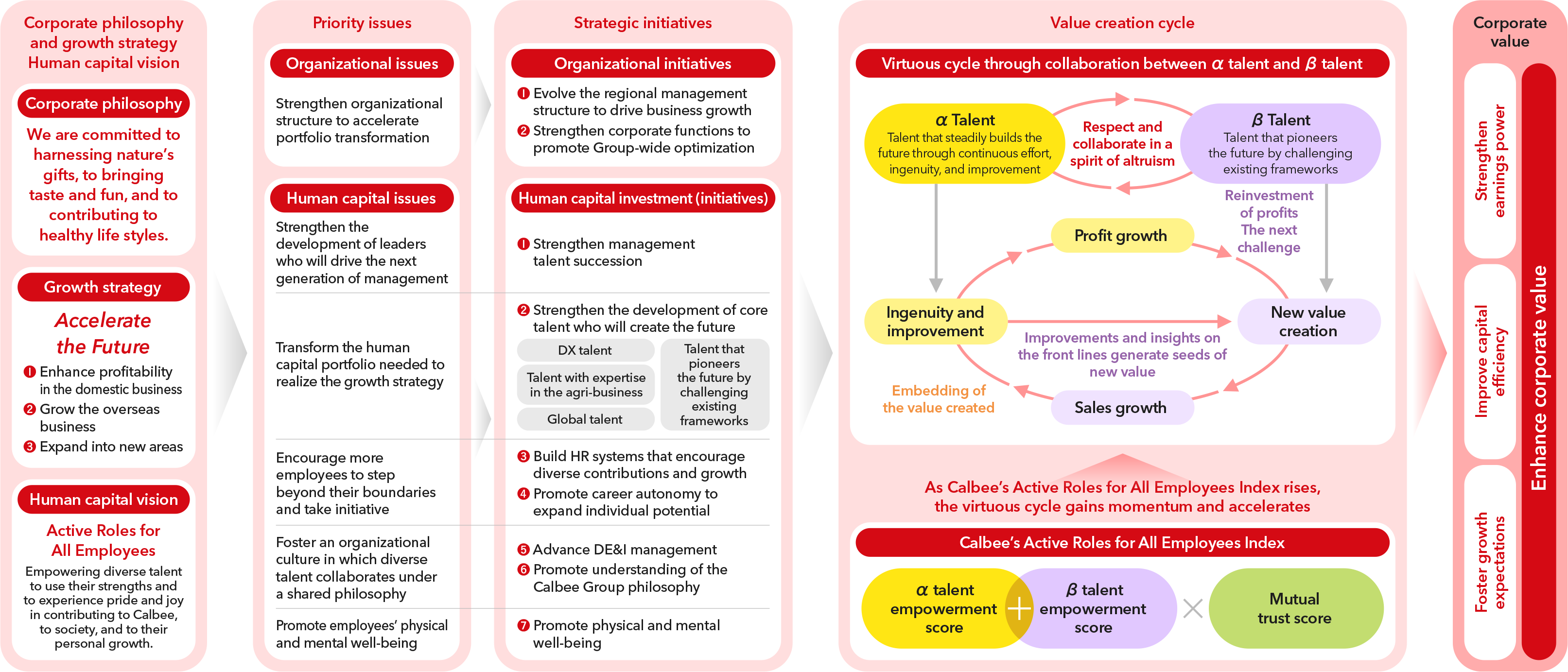
The Calbee Group is systematically implementing strategic initiatives to transform its people and organization in order to address the key challenges identified in the growth strategy. Through these initiatives, we intend to accelerate our value creation cycle and achieve stronger earning power, higher capital efficiency, and increased growth expectations as set out in the growth strategy, and ultimately increase our corporate value.
Virtuous Cycle Through Collaboration Between α Talent and β Talent
To ensure sustainable value creation, it is essential for the Calbee Group to increase the profitability of its existing business operations, particularly in Japan, and to take on the challenge of growing its overseas business operations and expanding into new business domains. The driving force behind this value creation is innovation. It involves not only developing new products and generating new business opportunities but also improving productivity and delivering high levels of quality, safety, and reliability through insights, ingenuity, and improvements accumulated in the course of daily operations. Accordingly, we have defined the following two types of people as the talent we seek: those who steadily build the future through continuous effort, ingenuity, and improvement (α talent) and those who pioneer the future by challenging existing frameworks (β talent). Both types of people are our most valuable asset, and we believe that altruism and mutual respect form the basis of "Active Roles for All Employees."
Ingenuity and improvement led by α talent will increase productivity and generate stable profits. The profits will provide financial resources for investment in overseas market growth and expansion into new business domains. Markets developed and new value created by β talent through challenges to existing frameworks will lead to customer base expansion and sales growth. α talent will continue to lead ingenuity and improvement to generate stable profits as business expands. Improvements and insights accumulated in the workplace will sow the seeds of new value. This virtuous cycle will boost profitability (profit increase) and growth (sales growth) and serve as the basis of stronger earning power, higher capital efficiency, and increased growth expectations. Collaboration between α talent and β talent is the key to accelerating this cycle. The more they draw on their respective strengths in a spirit of altruism, the higher the quality of ingenuity, improvement, and efforts to take on new challenges become, and the more robust the cycle becomes.
Calbee's proprietary Active Roles for All Employees Index (Human Capital Index)
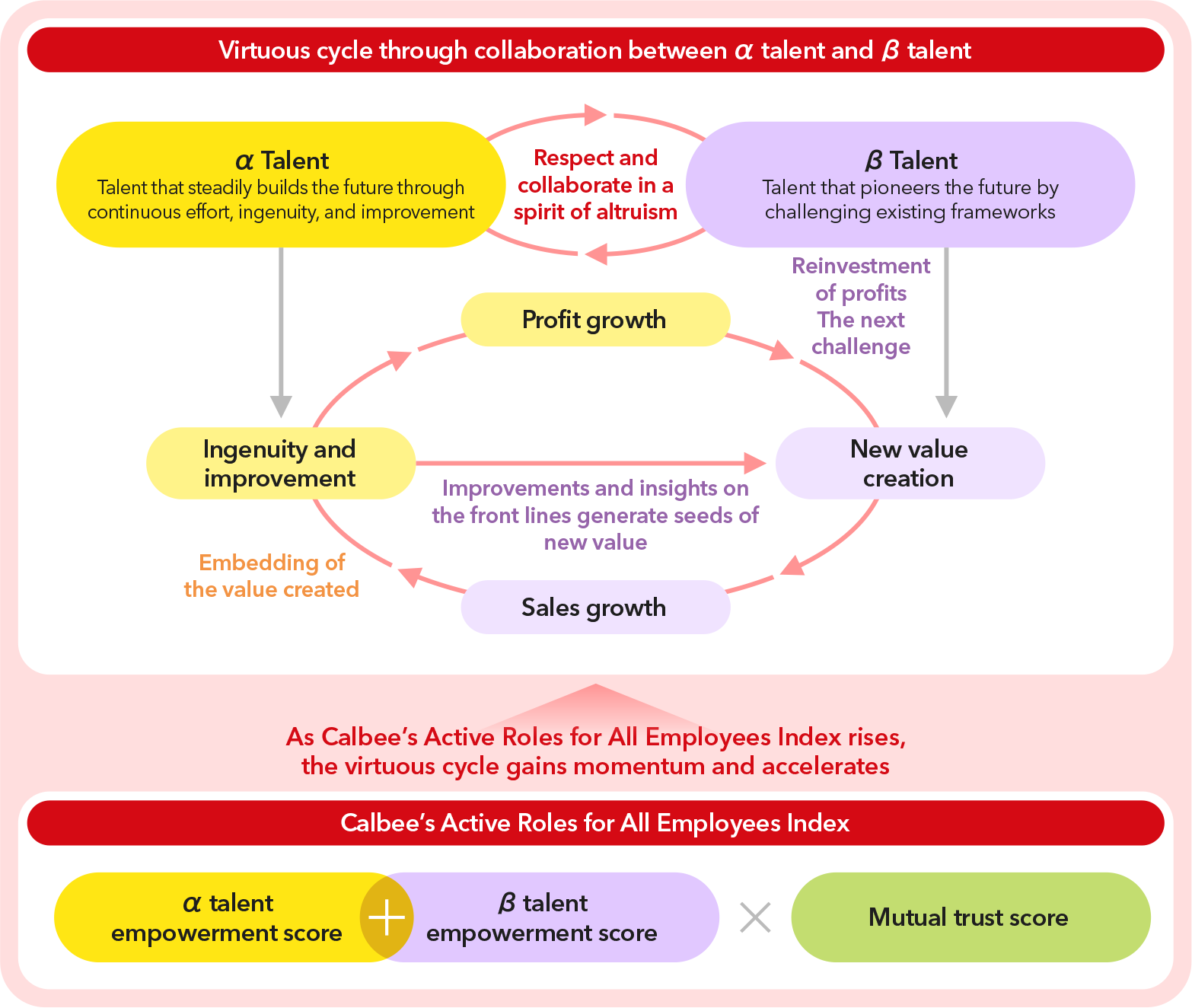
Calbee's Active Roles for All Employees Index (Human Capital Index) is our proprietary KPI that visualizes the extent to which "Active Roles for All Employees," the most important policy for our human capital management, is being achieved.
The index is calculated by combining the empowerment scores for α talent and β talent and then multiplying the result by a mutual trust score. The empowerment score measures each employee's progress and sense of contribution through day-to-day efforts from three perspectives, namely, Active Roles for All Employees status, career autonomy, and psychological safety. The mutual trust score measures the extent to which employees respect and collaborate with others with a spirit of altruism.
The higher the empowerment score, the more actively employees innovate, make improvements, and take on new challenges. Similarly, the higher the mutual trust score is, the stronger the collaborative corporate culture becomes and the more quickly the virtuous cycle operates.
The index for the fiscal year ended March 2026 was 80.67, an increase for the third consecutive year. Notably, the higher mutual trust score was a driver of the overall increase in the index. The empowerment score for both α talent and β talent rose, while the career autonomy score remained relatively low for both groups of people. This is a key challenge we should address.
Developing core talent that will shape the future
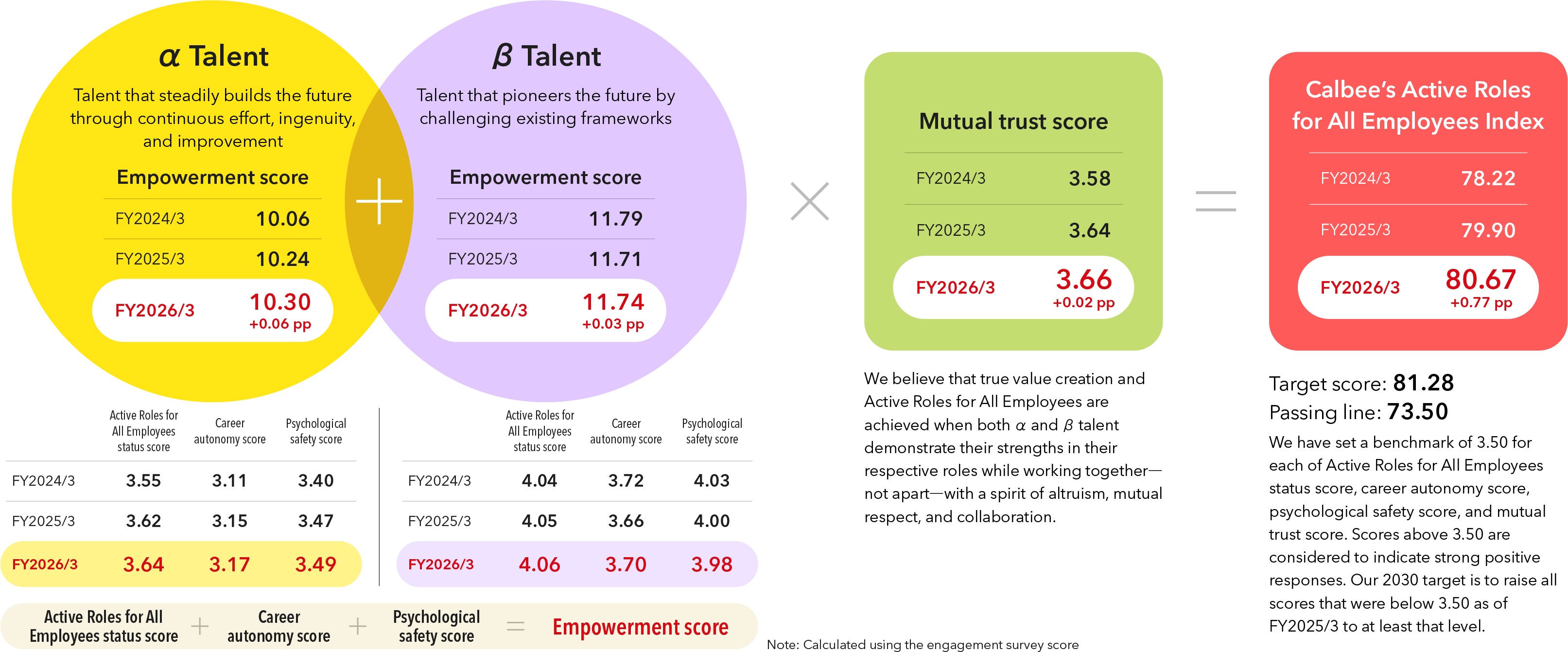
The Calbee Group faces a business environment where achieving growth simply by applying previous business strategies is becoming more difficult due to various factors, such as a shrinking market resulting from Japan's declining and aging population, growing health awareness, diverse dietary habits, and growing climate-related risks to ingredient procurement. In response to these environmental changes, we have identified three key directions in the growth strategy for 2035, "Accelerate the Future": improving the profitability of domestic business operations, growing overseas business operations, and expanding into new business domains, in order to transform our business portfolio. To make this transformation a success, it is also essential to transform our talent portfolio and align it with our strategy so that we have the people needed to drive the transformation.
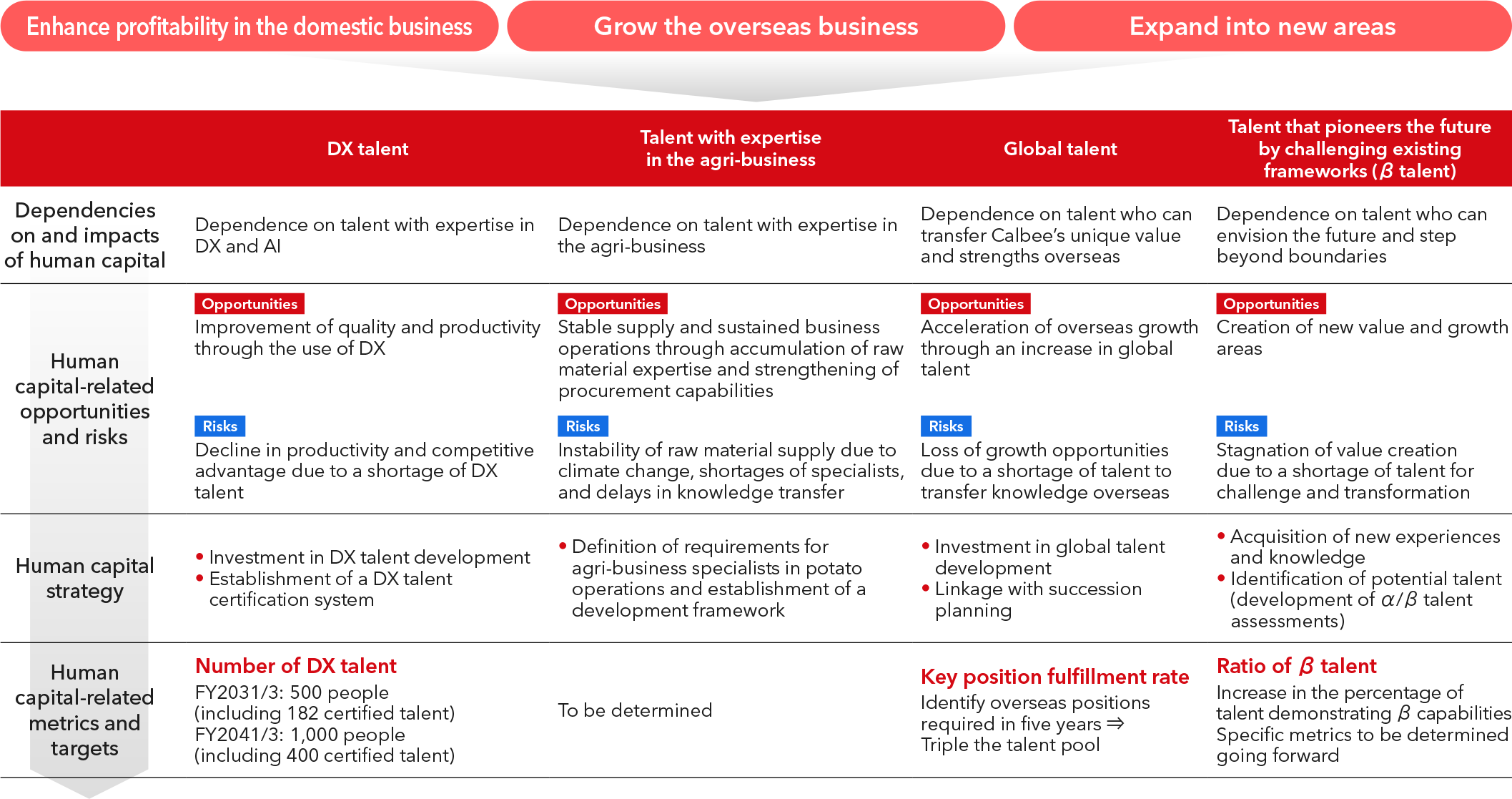
Four types of core talent behind the transformation
Based on this principle, we have identified four types of core talent that should be recruited as a top priority: DX talent, agricultural domain talent, global talent, and β talent (those who pioneer the future by challenging existing frameworks). By systematically securing, developing, and training these people, we are building a talent portfolio that supports our sustainable growth.
-
●DX talent
~Those who are responsible for improving productivity and product quality through the implementation of factory transformation (DX) and sales and operations planning (S&OP)~
In our domestic business operations, we are working to improve productivity and product quality as well as strengthen profitability by optimizing the supply chain through factory transformation (DX) and sales and operations planning (S&OP). To achieve this goal, we are focused on developing DX talent capable of successfully tackling challenges using DX and AI, and we have established a four-tier talent certification system consisting of DX master, DX expert, Data specialist, and Data trainee. We aim to increase the number of DX talent to 500 (including 182 certified members) by the fiscal year ending March 2031 through human resource development programs, including the AI Academy and the data analysis course (171 as of March 2026). We recognize that while the wider use of DX will lead to improved product quality and productivity, a shortage of DX talent or delays in training can lead to lower productivity and higher costs and undermine our competitiveness. -
●Talent with expertise in the agri-business
~Specialists who support the stable sourcing of natural ingredients~
The Calbee Group's operations are largely centered on natural ingredients, and we regard developing greater resilience to ingredient procurement risks associated with climate change as one of our key business challenges. Talent with expertise in the agri-business is responsible for ensuring consistent yields through variety development, labor-saving cultivation techniques, and advanced storage and transportation technologies, and plays a crucial role in maintaining a stable supply and sustainable business operations. Going forward, we will prioritize potatoes, our main ingredient, while also considering the use of other natural ingredients such as sweet potatoes, and formulate a potato talent portfolio, which divides the entire process from seeds to fields and ingredients into four areas: introduction of cutting-edge technologies, development of new varieties, establishment of storage technologies, and optimization of ingredients distribution. We will then define the requirements for talent with expertise in the agri-business and build a training framework. However, we recognize that a shortage of talent with expertise in the agri-business or delays in transferring knowledge can lead to instability in ingredient supply. -
●Global talent
~Those who communicate Calbee's uniqueness and strengths globally and work with local teams to promote its strategies~
In our overseas business operations, we are working to develop a proactive, locally integrated strategy framework, based on the technologies, expertise, and brand value that we have acquired in Japan. To achieve this goal, we are focused on developing those who have the ability to communicate Calbee's uniqueness and strengths globally and to drive growth in overseas markets. We will clarify key positions in each region and each function, consider candidates for management-level positions in line with succession planning for CXOs, and identify and appoint candidates for staff-level positions using the Global Talent Pool (human capital database). To increase our talent pool, we have launched a Global Course for graduate hires starting in 2027. We also have the Overseas Trainee Program, which is designed to equip employees with cross-cultural interaction skills through work experience at our overseas business locations, as well as the Calbee Next Leader Program (CNLP). We recognize that although an increase in global talent will accelerate our overseas business growth, a shortage of such talent can result in lost business growth opportunities. -
●β Talent
~Those who pioneer the future by challenging existing frameworks~
The Calbee Group is working to create new value and expand into growth areas as well as strengthen its competitiveness in existing business operations. To achieve this goal, we are focused on identifying and developing people who proactively explore untapped areas, embrace change, and create new value and growth opportunities beyond existing frameworks. Such talent will play a crucial role in shaping the Calbee Group's future growth through business creation, market exploration, and new technology and framework development, among others. We recognize that although an increase in talent that is ready to take on challenges and promote transformation will create new value, a shortage of such talent and delays in taking on challenges can result in lost opportunities for future growth.
Advancing DE&I management
The Calbee Group is advancing DE&I management that empowers diverse talent to draw on their individuality and strengths to create value for society and our customers. We are committed to providing a working environment where all employees can thrive in their own ways regardless of gender, nationality, age, disability, or values. This includes fostering greater psychological safety and a supportive workplace atmosphere. We ensure that team collaboration, both horizontal and vertical, drives innovation by leveraging diverse values and strengths.
Promotion framework
The department specializing in promoting DE&I was established and began full-scale operations in 2010. Currently, the All Employees Participation Promotion Office of the Head Office is working on this together with the human resources promotion staff at each business entity (including Group companies). In addition to implementing company-wide activity measures, we are also taking actions to solve problems and increase the level of penetration at each business entity.

Promotion of empowerment of female employees
Women account for nearly half of Calbee’s entire workforce. Based on our belief that the active participation of women accelerates the Calbee Group’s growth, we aim to increase the number of female employees in management roles to at least 30% by FY2030, so that female representation in the decision-making process would be proportional to the percentage of women in our workforce.
Under the leadership of top management, we are systematically and continuously promoting women’s advancement in the workplace, organizing a range of training programs and workshops, and striving to create a pleasant and rewarding workplace environment.
Percentage of women in management roles

Initiatives to support the active participation of women
| Initiatives | Program description |
|---|---|
| Food manufacturers’ joint training program for female employees | A training program that allows participants to learn from other food manufacturers as role models to help them take a step forward toward their future career goals. |
| Female leader development program | A selective training program aimed at future leader candidates to help them keep a good work-life balance, develop a career mindset, and improve problem-solving skills. |
| Inter-company networking program for female managers | Training for female employees in management roles to improve their skills to solve organizational issues by involving those around them, and at the same time expand their network outside the company to use as a springboard for playing even greater roles in the future. |
| Seminar for returning to work after childcare leave | Participants develop a mindset and the know-how to balance work commitments and childcare responsibilities through conversations with superiors and from the experiences of seniors to help them return to work with confidence after childcare leave. |
| Communications support from the pregnancy to preschool phase | As part of supporting female employees from pregnancy to the preschool phase of their child’s life, they are provided with a handbook that explains when and how to communicate with supervisors and junior staff, allowing them to take time off smoothly and transition back to work. |

Female leader development program
Promoting physical and mental well-being
We have made steady improvements to our environment that supports employees' physical and mental well-being by expanding the health support system for employees and implementing initiatives to promote health and well-being. While we are working to prevent absenteeism and leaves of absence due to illness or mental health problems, we are aware that presenteeism, a situation in which employees are unable to perform to their full potential despite being physically at work, affects productivity. It is therefore a key challenge to enhance employees’ awareness of their health and encourage a proactive approach to maintaining good health. We strive to ensure that all employees are both mentally and physically healthy and can demonstrate their strengths and thrive in the workplace. To this end, we support and encourage more flexible workstyles and promote physical and mental well-being.
Initiatives to support diverse and efficient workstyles (Changes in workstyle reform over the years)
Since the introduction of the flextime system in 1991, the Calbee Group has undertaken workstyle reform in response to changes in society. We have made phased improvements to our work environment to enable employees to choose how they work and to work efficiently and productively. The improvements include the introduction of the Home Teleworking Program in 2014, the removal of restrictions on work location and frequency under the Mobile Work Program in 2017, and the elimination of core hours in 2020.

Schemes that support diverse workstyles
| Main schemes | Program description |
|---|---|
| Mobile work | Launched the Home Teleworking Program in 2014. Removed restrictions on locations and frequency in 2017. |
| Return entry | Employees who have left Calbee due to life events or career opportunities and wish to rejoin the company are given priority in the recruitment process. |
| Full flextime | Introduced flextime in 1991. Discontinued the core time system (the time when employees must be at work) in July 2020. |
| Employee application remote work system | If the company determines that work can be done effectively through a mobile work-based approach, employees may work either on business trips or at the closest office without having a residence at the location of the organization they belong to. |
Transition to a hybrid work format
In 2025, Calbee transitioned to a hybrid work format, which flexibly combines mobile work and working in the office, enabling employees to independently choose the location and time of their work by working backward from the objectives and outputs of their jobs.
The COVID-19 pandemic demonstrated that office workers can effectively execute their duties from mobile workstations. At the same time, it reminded us of the importance of face-to-face communication. Ultimately, this resulted in more employees coming to the office frequently and engaging in face-to-face activities both within and outside their teams.
We have developed an environment that allows both superiors and team members to opt for face-to-face communication when needed, while leveraging the respective advantages of office work and mobile work through the hybrid work format. We aim to maximize output by allowing the team and individuals to choose their own locations and working hours independently. In conjunction with this transition, we renovated and expanded our head office, and it now serves as a space where people can work across organizational boundaries, both within and outside the company, to deliver results.


Office space at the Head Office
Initiatives to promote health and well-being
Based on the idea that the health of employees and their families is an essential component of corporate growth, the Calbee Group has been engaged in full-fledged health and productivity management initiatives to support the mental and physical health of employees since 2016. We aim to be a health-focused company where employees can lead healthy and fulfilling lives, both physically and mentally, and work with energy and enthusiasm, motivated to take on new challenges. To this end, we are taking two approaches: improving their health literacy both in terms of knowledge and behavior and actively involving healthcare professionals who provide specialized support. The health promotion department, based on the Calbee Group Health Declaration, plays the central role in driving forward the Group’s health and productivity management. Supervisors and workplaces, on-site staff, occupational physicians and nurses, and the Calbee Health Insurance Association collaborate to build a mechanism that allows every employee to excel on the job.
Structure

As primary prevention measures, we promote health literacy through streaming lectures by occupational physicians and line care training for managers, while implementing a complete ban on smoking anywhere on company premises based on the Stop Smoking Declaration issued in 2017 and measures to prevent overwork.As secondary and tertiary prevention measures, we support the early detection of illnesses and the balance between medical treatment and work through a 100% health checkup take-up rate, annual stress checks, return-to-work support, and a self-help group for cancer survivors.
Certified as a 2026 Outstanding Health & Productivity Management Organization